Historical Review of Las Vegas: Steve Wynn
Steve Wynn is regarded as one of the most successful businessmen in the world. Whole books could be written about him. In this report, we therefore focus on his contribution to the casino world of Nevada and other states. His rise in this industry is unique, as are his skills in communicating with the media and business partners, and not least his way of motivating his own employees to peak performance and keeping them with his companies for many years.
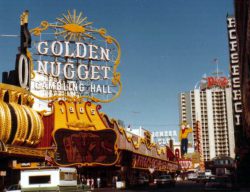
As the son of a bingo operator from the East Coast, Stephen Alan Wynn grew up around casinos from an early age. With a degree in English literature from the University of Pennsylvania, he then headed for Las Vegas, where he was to make quite an impact.
One of his closest friends and business partners, E. Parry Thomas, president of the Bank of Las Vegas, helped him finance his casino projects. As early as 1967, Steve Wynn seized the opportunity and bought a few shares in the Frontier Hotel. In 1971, with the help of his banker friend Thomas, he bought majority shares in the Golden Nugget in Downtown Vegas. By restructuring the hotel and enlarging it by another 600 rooms, he turned the Golden Nugget into a luxury hotel which, even today, has not lost its charm in Old Las Vegas.
Further investments were to follow, among them on the East Coast, where he built the Golden Nugget in Atlantic City, only to sell it later at a massive profit. He used this profit to realise his biggest project, which was to set new standards in Las Vegas: "The Mirage".
After about two years of construction, the Mirage Hotel and Casino Resort opened on 22 November 1989. The construction costs came to around 630 million dollars, making it the most expensive hotel-casino in history up to that time. The recruitment of staff took months, during which Steve Wynn personally held interviews and seminars. Only those who were 100 % motivated and convinced of his concept were to work for him. This is one of the reasons why many employees have stayed loyal to the Mirage, some of them for decades. That is highly unusual when you look at an average American working life.
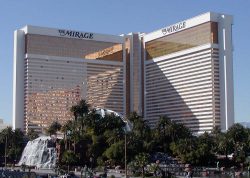
Designed by Joel Bergman, the Mirage has 3,044 rooms in a 29-storey hotel complex made up of three wings.
Besides the regular standard rooms, suites, luxury suites and super-luxury suites, there are also 6 bungalows with a private garden and their own swimming pool. The top 5 floors of the hotel complex, which have a golden finish on the outside that also serves as advertising space for current shows, are reserved for the penthouse suites.
As a visitor to Las Vegas, you should not miss the nightly spectacle in front of the Mirage: at regular intervals an artificial volcano erupts there and draws the crowds. Also remarkable is the Mirage's pool and water landscape, with a large dolphinarium as an additional attraction, which was not opened without sceptical protests from environmentalists.
For years, the Mirage Hotel and Casino was the most successful casino in Las Vegas. Its poker room was regarded at the time as the headquarters of the world's poker professionals and is still a very busy place for card players today. The clever marketing strategy was to pay off in full. With a private casino for high rollers, which you cannot enter at all without an invitation, and a regular, open high-limit area, the Mirage was a magnet for wealthy players from overseas. Within its first year of operation, the Mirage generated around 125 million dollars at the slot machines and the same amount again at the baccarat tables alone. This was due to the fact that intensive marketing was carried out to attract high-limit baccarat players from the Far East. In addition, around 250 million dollars were generated from the "non-gaming" area. A sign that Las Vegas was slowly developing from a pure gambling town into an entertainment metropolis.
Incidentally, the Mirage Hotel has a private golf course, laid out a little way off the Strip especially for high rollers and acquaintances of Steve Wynn – and of course for himself. According to reports, this exclusive golf course is hardly played and yet causes such enormous costs that rumour has it Steve Wynn created a private realm here for himself and his friends. Important people from the casino industry are lifetime members there and have their own private locker areas. Non-members are not admitted; the club is completely fenced in and strictly guarded around the clock. Only the overflight rights are not regulated by law, and so you can get an impression of Steve Wynn's golf realm from the air.
In order to keep coping with the rush of tourists, it was decided not to enlarge and extend the Mirage, as is otherwise customary with hotel-casinos in Las Vegas, but to invest straight away in a completely new resort right next to the Mirage. And so, on 27 October 1993, the Treasure Island Hotel and Casino, another mega-casino with 2,900 hotel rooms, opened its doors. The opening took place at the same time as the implosion of the Dunes Hotel and rode the wave of themed casinos. Treasure Island has a 36-storey hotel tower and cost somewhat less than the Mirage – "only" 430 million dollars. Visitors can ride a tram back and forth between the two casinos.
As with the Mirage, a show is also put on in front of Treasure Island to attract the crowds and then lure them into the casino. According to speculation, the pirate show "Buccaneer Bay", which ran for a decade, had a rather interesting background. The show depicts a battle between pirates and the British frigate "H.M.S. Britannia". In the end, the pirates win and the British soldiers go down. What makes the whole thing so interesting? Steve Wynn's project of a Golden Nugget casino in London failed shortly before the negotiations were concluded. At that point the project had already been fully worked out and all the necessary buildings had been acquired. The licence was refused, presumably because it was feared that Steve Wynn's influence in the local market could become serious competition for the other operators. And so it is speculated that Steve Wynn and his marketing strategists launched the pirate show to poke fun at the arrogant British behaviour.
Steve Wynn's business activities did not decline even after his exit from the MGM Grand–Mirage merger. In 2000, he bought the Desert Inn Hotel and Casino for his wife and promptly had it closed. The Desert Inn, which had been renovated for more than 200 million dollars only a few years earlier, was later razed to the ground. The Desert Inn Country Club and golf course, however, still exist in their original form and were attached to the Wynn Resort, which opened a few years later.
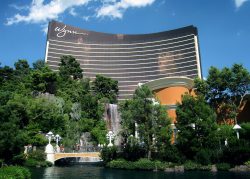
The Wynn Las Vegas Hotel and Casino opened on 28 April 2005, the birthday of Steve Wynn's wife, and once again set standards in Vegas. With construction costs of 2.7 billion dollars, Wynn Las Vegas is the flagship of Wynn Resorts Limited. With just over 2,700 rooms, it is smaller than many another hotel in Las Vegas, but the goal here was not size but luxury. Every stay at Wynn Las Vegas is meant to be a unique experience for the guest. And so, to this day, the Wynn holds more Forbes Travel Guide Five Star Awards than any other independent hotel company in the world. Besides countless luxury suites, Wynn Las Vegas of course also has a casino of around 10,000 square metres, the 12,000-square-metre "Lake of Dreams", numerous restaurants and bars, its own art gallery, two wedding chapels and, last but not least, with the former Desert Inn Country Club, its own golf course.
The original view that the casino's location was no longer up to date quickly proved wrong, and the Wynn reached its capacity limits fairly soon. Finally, on 22 December 2008, after two years of construction, the "Encore" opened as a sister hotel to Wynn Las Vegas, with the same high standards of luxury and service.
Every project opened under Steve Wynn ended up firmly in the black, and that proves the astonishing management skills of this casino manager. Let us wait and see what comes next.
Sources
The facts were checked against the following sources:
- Wikipedia, Steve Wynn (studies at the University of Pennsylvania, graduated 1963; sale of the Golden Nugget in Atlantic City in 1987; purchase of the Desert Inn in 2000 for 270 million dollars): https://en.wikipedia.org/wiki/Steve_Wynn
- Wikipedia, The Mirage (opening on 22 November 1989, construction costs of 630 million dollars, 3,044 rooms, architect Joel Bergman): https://en.wikipedia.org/wiki/The_Mirage
- Wikipedia, Desert Inn (renovation in 1997 for 200 million dollars, closure in 2000): https://en.wikipedia.org/wiki/Desert_Inn
- Las Vegas Sun, Crowds flock to Wynn (opening on 28 April 2005 on Elaine Wynn's birthday, construction costs of 2.7 billion dollars): https://lasvegassun.com/news/2005/apr/28/crowds-flock-to-wynn/
- Wikipedia, Wynn Resorts (opening of the Encore on 22 December 2008): https://en.wikipedia.org/wiki/Wynn_Resorts
- The figures on the Mirage's revenues in its first year, the golf course and the background to the pirate show are based on the ISA Guide report and can no longer be verified today.