Interview with Dr Wulf Hambach – Lawyer
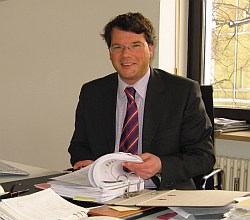
Dr. jur. Wulf Hambach studied law in Regensburg and Hamburg. He was admitted to the bar in April 2003. Already during his legal clerkship and his doctorate, which he wrote at the Max Planck Institute for Foreign and International Private Law, he specialised in media and gambling law.
He gained experience abroad at, among other places, the German American Chamber of Commerce in Houston (USA). From 2000 to 2001 he worked for the renowned commercial law firm Westphal Voges und Krohn and for the media company Verlagsgruppe Milchstrasse in Hamburg. Until 2005 he worked in the field of gambling/betting law at the law firm Arendts Anwälte.
He is co-founder of the law firm Hambach & Hambach Rechtsanwälte and has specialised in the following areas of law: international and European betting and gambling law, media law.
Reinhold Schmitt: What is your position?
Dr. Wulf Hambach: I am a lawyer and co-founder of the law firm Hambach & Hambach Rechtsanwälte.
Reinhold Schmitt: Which areas of law do you mainly work in?
Dr. Wulf Hambach: My work and the focus of the firm Hambach & Hambach Rechtsanwälte lie exclusively in international and European gambling law. However, the term “gambling” law should not be taken literally here. For new forms of betting and gaming, such as financial bets, betting exchanges or a large number of online games, there is as yet no established (legal) experience. The reason: the German legislator (apart from passing the Lottery State Treaty, which in my view is contrary to the constitution and European law) is very sluggish, especially in this area. For the time being, it still leaves legal clarification to the courts, even though the German legal system is actually based on codification and not on a case-law system.
Reinhold Schmitt: Are you active in other areas besides sports betting law?
Dr. Wulf Hambach: Besides domestic and foreign clients in the field of sports betting law, I advise companies that specialise in online and offline “gambling”, at both national and international level. The field of (international) gambling law covers a large number of interlocking areas of law, so that my work is characterised by its cross-disciplinary nature. The main ones are online law, European law, administrative law, criminal law and also media law. With regard to financial bets, the rules of banking and stock exchange law play a key role. My law partner and brother, lawyer Claus Hambach, who has been a lawyer for banking and capital investment law for about 6 years, can give you more detailed information on this. He believes that financial bets and digital options will increasingly become the focus of interest in the near future, especially among risk-loving private investors. For they offer considerable advantages over investment and trading opportunities through stock exchange trading in shares or conventional financial derivatives. In particular, the simple construction of these new financial instruments makes trading interesting for investors – compared with the complicated value and price determination of classic options transactions. Trading in “pure financial bets” (binary bets, fixed odds and spread bets) also does not require eligibility for forward transactions, as classic warrants do.
Reinhold Schmitt: You have recently been practising together with your brother. Are there reasons for that?
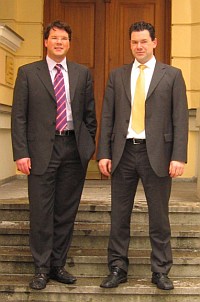
Dr. Wulf Hambach: There are many reasons for joining forces with my brother. On the one hand, it is literally a matter of the heart, since the understanding between us has been exceptionally good for as long as I can remember. The team spirit that has developed in recent years of working together is particularly important to us. Last but not least, however, the professional complementarity – as already indicated above – is also an essential reason.
Reinhold Schmitt: How did you come to the field of sports betting law?
Dr. Wulf Hambach: Even as a child I was passionately interested in professional sport. When I got the chance to handle a sports betting mandate, I was immediately fired up and steadily built up this area.
Reinhold Schmitt: You represent one of the largest sports betting providers worldwide. What are currently the legal sticking points in Germany for your clients and other foreign providers?
Dr. Wulf Hambach: The state monopoly, which takes shape in the State Treaty on Lotteries and in the state laws (in conjunction with Section 284 of the Criminal Code), must be broken. The reference to the incompatibility of the aforementioned laws should, however, not only be overcome in individual court decisions. I consider media-effective public relations work – at national and international level – to be a further sticking point.
Reinhold Schmitt: Hasn't something fundamental changed in this respect as a result of the Gambelli judgment?
Dr. Wulf Hambach: Definitely. The State Treaty on Lotteries in particular fails to meet the requirements laid down by the ECJ in the Gambelli judgment. The consistent restriction policy of the member states demanded by the ECJ is not followed in Germany. The inherently contradictory behaviour of the federal states – namely that on the one hand they want to punish private gambling, and on the other hand they unrestrainedly launch new gambling offers (keyword: Keno) and advertise them aggressively – is by now well known and has not been tolerated by many courts. Now the current football scandal also reveals the considerable deficits in state fraud prevention. If the ECJ, in paragraph 67 of its judgment, expressly demanded that sports betting may only be restricted to state providers for reasons such as effective fraud prevention, then this demand is obviously not being met in Germany.
Reinhold Schmitt: You also deal very intensively with sports betting at European level. For example, you recently wrote for the 7th edition of the “Internet Gambling Report”. What does the legal situation regarding sports betting look like in the other European countries?
Dr. Wulf Hambach: It varies. On the one hand, there are member states in which the sports betting market is in private hands. Corresponding betting laws guarantee the smooth and scandal-free functioning of this market here. Great Britain, Austria and also smaller states such as Malta are role models in this respect. On the other hand, there are member states such as France, Denmark or Germany in which there is a state betting monopoly. It is striking that in the states that have opted for controlled privatisation, there are by no means more problems than in countries with a state betting monopoly. The football scandal that is currently causing an uproar in Germany clearly shows that state providers are not immune to manipulation either.
Reinhold Schmitt: In the long run: do you think Germany will be able to permanently resist the pressure for liberalisation in the sports betting sector?
Dr. Wulf Hambach: No. The state sports betting monopoly faces the same fate as other state monopolies before it, such as the state telecommunications monopoly. The large number of court decisions in favour of liberalisation (e.g. VGH Hessen, Schleswig-Holstein, Saxony) has already mapped out the way.
Reinhold Schmitt: Does the EU intend to harmonise the law on sports betting, or gambling in general, in the foreseeable future?
Dr. Wulf Hambach: Brussels intends to harmonise – that much is certain. But what the harmonisation measure in the field of gambling will look like in concrete terms is still written in the stars. The adoption of an EU directive harmonising gambling in Europe would be desirable. At present, however, Brussels is still in the discussion phase. In January 2005 the EU Commission commissioned the “Swiss Institute of Comparative Law” with the “Study of gambling services in the internal market of the European Union”. At the end of the year the institute will explain to the Commission whether the internal market in this area functions smoothly or not. In my estimation the answer – a clear “No” – is already predetermined. Overall, one hears from Brussels that harmonisation of the gambling sector is being aimed for by 2008.
Reinhold Schmitt: What many of our readers do not really understand: in daily practice, what distinguishes a state provider such as Oddset from a private sports betting provider? What are the similarities and the differences?
Dr. Wulf Hambach: Like ODDSET, private providers that hold licences from Austria and England, for example, offer their bets in betting shops and on the internet. The German Lotto and Toto block maintains no fewer than 26,000 outlets nationwide. The number of private shops is estimated at about 500, with most shop operators in legal conflict with the authorities. A key difference is the level of security and consumer protection: it is telling that most private sports betting providers, unlike ODDSET (and its customers!), suffered no damage from the fixed DFB Cup match HSV against SC Paderborn. The reason is simple: most private providers have effective early warning systems, such as the “Betradar” system. If unusually high stakes on a so-called “underdog” are registered before kick-off, the system automatically warns the operator, and he can still take the match off the betting programme shortly before the start on suspicion of manipulation and refund the stakes to his customers. In the DFB Cup match in question, ODDSET should actually have taken the match off the betting programme before kick-off because of the unusual stakes placed on the “underdog” Paderborn one day before kick-off. For system reasons, however, this was no longer possible, to the detriment of ODDSET and its customers. Not least because of this, I see consumer protection as being flagrantly violated.
Reinhold Schmitt: Where do you see sports betting law in 5 years? And where in 10 years?
Dr. Wulf Hambach: In five years, in my opinion, we will have “Austrian conditions”: a liberalised but consistently controlled and regulated sports betting market. In 10 years the German gambling market will be more like the English one, i.e. an appropriately regulated gambling market. The aim must be to shape consumer-friendly, modern laws for regulating the German gambling market. But there is still a long and stony road ahead of us until then.
Reinhold Schmitt: A decision of the BVerfG (Federal Constitutional Court) on sports betting law has been announced for 2005. What exactly is it about? And would you venture a forecast on the outcome?
Dr. Wulf Hambach: The Federal Constitutional Court will – as it has announced – make a landmark decision on whether the private brokering of sports bets is permitted in the light of the betting shop operators' freedom to choose an occupation. The constitutional complaint of the Munich complainant has already been pending before the Federal Constitutional Court for three years. There are serious indications that the Federal Constitutional Court will consider the restriction policy of the state of Bavaria towards the private sports betting entrepreneur to be unjustified.
Reinhold Schmitt: Is a platform such as ISA-CASINOS PA important to you?
Dr. Wulf Hambach: The ISA-CASINOS PA platform serves me as an indispensable source of information on all aspects of gambling. I am particularly pleased that a focus is placed on the legal background in this area.
Reinhold Schmitt: What comes to mind spontaneously when you think of amusing incidents during your work?
Dr. Wulf Hambach: Amusing, if at the same time scandalous, is certainly the dispute in which ODDSET and the DFB are virtually tearing each other apart in the course of the football scandal. Against the background that the DFB is co-financing the supporting programme of the 2006 World Cup with the state sports betting operator, this feud reminds me of a peasant farce: cover up, suppress and shift the blame onto others.
Reinhold Schmitt: If you had three wishes, what comes to mind spontaneously apart from wealth?
Dr. Wulf Hambach: In view of the terrible images from the war zones around the world in Iraq and Israel: peace! A happy family life and health come next. And of course I would wish that FC Bayern Munich wins the Champions League, on which I have placed a bet (not with ODDSET ;-)).
Reinhold Schmitt: How do you relax in your free time?
Dr. Wulf Hambach: I am a passionate tennis player and, as often as my job allows, I go to the nearby mountains – mountain biking in summer and skiing in winter. I am also a big U2 fan and am really looking forward to the concert in Dublin – it’s goin’ to be deadly!
Reinhold Schmitt: Thank you very much for the interview.
Sources
The facts were checked against the following sources:
- European Court of Justice, judgment of 6 November 2003, Case C-243/01 (Gambelli): https://eur-lex.europa.eu/legal-content/DE/TXT/?uri=CELEX:62001CJ0243
- The statements in the interview come from Dr Wulf Hambach himself.