Interview with Ruedi Schneider – Deputy Director and Head of Supervision (ESBK)
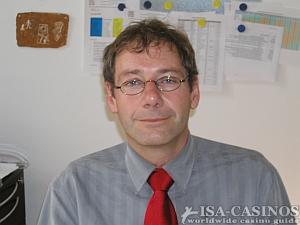
Ruedi Schneider, born in 1959, deputy director and head of the supervision division (head of the organisational unit responsible for supervising the casinos and collecting the casino levy), by profession a "Fürsprecher" (the Swiss term for lawyers admitted to the bar), postgraduate studies with an Executive MBA HSG, father of two sons (12 and 15 years old).
Reinhold Schmitt: Since when have you been working at the ESBK?
Ruedi Schneider: Since 1 February 2004.
Reinhold Schmitt: What are the tasks of the ESBK?
Ruedi Schneider: The ESBK supervises the casinos, in particular monitoring their compliance with the statutory provisions. It also collects the casino levy and combats illegal gambling.
Reinhold Schmitt: Is the ESBK purely a supervisory body, or can it also adopt laws and ordinances?
Ruedi Schneider: The ESBK is primarily a supervisory body. Passing laws is the sole responsibility of parliament. Ordinances generally fall within the competence of the government (in Switzerland, the Federal Council). The ESBK is, however, responsible for preparing all gaming-related regulations. Under the provisions of the Anti-Money Laundering Act, it is the special supervisory authority for casinos in this area. As such, it is entitled to issue implementing provisions at ordinance level.
Reinhold Schmitt: Do you believe that the ESBK, with its clear ordinances on money laundering, gambling addiction and admission control, is a model for neighbouring countries?
Ruedi Schneider: I cannot judge how our system is perceived in neighbouring countries. However, we note that various supervisory authorities from other countries are very interested in our social concept, which is intended to prevent the socially harmful effects of gambling. We are happy to present and explain this concept to them. It would be interesting for us if one day it were possible to enforce internationally the gaming bans that our casinos impose on compulsive gamblers. The effectiveness of the social concept would thereby be strengthened insofar as these bans could no longer be circumvented by switching to foreign casinos. The social concept is primarily meant to protect the players. However, the casinos – and most Swiss casinos have recognised this – also have an interest in this instrument working. In the medium to long term this also makes sense from a business point of view.
Reinhold Schmitt: Are you one step ahead of your neighbouring countries with your laws and regulations?
Ruedi Schneider: To claim that would probably be somewhat presumptuous. After all, our neighbours in which casinos are permitted can look back on a much longer gaming tradition. In Switzerland the constitutional ban on casinos was only lifted in 1993. After long discussions the Casino Act was passed at the end of 1998 and brought into force on 1 April 2000. In 2001 the Federal Council, our national government, held out the prospect of a licence to 21 applicants. After the formal granting of the licences, the casinos began operating in 2002 and 2003. The system did settle in well quickly. Nevertheless, the ESBK always strives to initiate and make improvements on the basis of the experience gained – including to the existing legal framework.
Reinhold Schmitt: Which associations do you work with in the field of gambling addiction?
Ruedi Schneider: The ESBK itself does not work with associations in this field. Among others, we employ a psychologist who maintains contacts with such institutions. We work together with the national health authorities and with the cantonal addiction officers. All casinos, on the other hand, collaborate with experts in this field.
Reinhold Schmitt: In Switzerland there is still the distinction between A and B casinos. Is that still up to date?
Ruedi Schneider: When the licences were granted in 2001, the Federal Council already instructed the ESBK to report to it in 2006 on whether changes should be made to the number of licences. In this report the ESBK will also comment on this question. I cannot and will not anticipate the answer, for which I ask your understanding.
Reinhold Schmitt: Aren't there B casinos that already have higher turnover than A casinos?
Ruedi Schneider: Yes. In 2004 two B casinos achieved gross gaming revenues higher than those of the three A casinos that were "bottom of the table" in this respect.
Reinhold Schmitt: How do bans on setting up machines with money stakes affect the overall result of the casino industry?
Ruedi Schneider: The Casino Act stipulates that gambling outside casinos is not permitted. Under transitional law, gaming machines in restaurants, amusement arcades etc. were tolerated for another five years. This transitional period expired on 1 April this year. In the 13 cantons whose legislation permitted such machines, a total of around 6’000 machines had to be removed by that date. It can be assumed that a certain number of players will move to the casinos. It is not yet possible to quantify this effect at present.
Reinhold Schmitt: Hasn't a private line of business, found mainly in restaurants and spa halls, been brought to a standstill here?
Ruedi Schneider: Today the gaming machine manufacturers are trying to bring automated games of skill permitted under the Casino Act onto the market – games in which winning depends mainly on the player's skill and not on chance. There are indeed problems here. Apparently there are skilful players who regularly empty the machines. Unskilful players show only moderate interest. The manufacturers are trying to adapt the software. They are under enormous economic pressure. There have been redundancies in the industry. The ESBK regrets this. However, the legal framework is clear on this question. The legislator attached importance to creating a clear separation between gaming machines and skill machines. Previously there was a grey area here. It considered this undesirable. It remains to be seen whether the industry succeeds in creating new innovative products that are successful on the market.
Reinhold Schmitt: What is the advantage for the player that he may now only play these machine games in casinos?
Ruedi Schneider: One objective of the Casino Act was to prevent the socially harmful effects of gambling. That is why one condition for obtaining a licence was the existence of a suitable social concept. Within this concept the procedures are laid down for how customers must be observed. If behaviour is conspicuous, the casinos approach the players. If the conversation shows that gambling is a problem for the person concerned, the casino takes measures. Possibly an agreement on a voluntary admission restriction is made. The player can thus limit the number of casino visits during a certain period or the sums staked. If necessary, he is banned, so that further – unfortunately frequent – indebtedness can be stopped. All these measures can only be taken if the player is accompanied by trained staff. Only a casino can offer this necessary infrastructure. That is where the objective advantage lies, even if the player may not always perceive it that way subjectively.
Reinhold Schmitt: What is the ESBK's position on the lottery companies and their Tactilo machines? Are there firm and binding regulations on this?
Ruedi Schneider: It is disputed whether the Tactilo machines are ordinary gaming machines, which under casino legislation could only be operated in casinos, or whether they fall under lottery legislation and therefore follow other rules. The ESBK has opened administrative proceedings in this matter in order to clarify this question. It will shortly issue a ruling making a determination in this respect. If this ruling conflicts with the interests of the lottery companies, it will certainly be challenged. It will then be up to the Federal Supreme Court – as the court of last instance – to clarify the question definitively.
Reinhold Schmitt: Are there any known plans to legalise online casinos in Switzerland?
Ruedi Schneider: No.
Reinhold Schmitt: Are Swiss people allowed to play in online casinos?
Ruedi Schneider: Yes. In Switzerland only the operation of Internet gambling is prohibited.
Reinhold Schmitt: What do you say about German casinos possibly becoming liable to VAT on their gaming machines?
Ruedi Schneider: I do not want to comment on that.
Reinhold Schmitt: Is there such a law in Switzerland?
Ruedi Schneider: Switzerland has a turnover levy. What is taxed is the gross gaming revenue from table games and machines. The basic levy rate is 40 per cent. It is charged on gross gaming revenue up to 10 million for B casinos and up to 20 million for A casinos. For each additional million, the marginal rate rises by 0.5 per cent up to the maximum rate of 80 per cent. The tronc is not subject to the casino levy. What is important – and this was also the will of the legislator – is that, given the fiscal burdens as a whole (the casino levy is only one element), the casino can operate economically successfully if run professionally.
Reinhold Schmitt: How do you spend your free time?
Ruedi Schneider: In winter I am a passionate skier. In summer I am drawn to the water. I am lucky enough to have a small holiday house with a garden right on the lake in a wonderful part of Switzerland – on Lake Biel. My partner also owns a sailing yacht. There is nothing better than spending the weekend on the lake in the sunshine, lying at anchor at night and philosophising about life over a simple meal and a good glass of wine. Apart from that I listen to music, preferably jazz.
Reinhold Schmitt: Mr Schneider, thank you very much for the interview.
Sources
The facts were checked against the following sources:
- Swiss Federal Department of Justice and Police (EJPD), press release "Aus für Glücksspielautomaten" of 28 December 2004 (end of the five-year transitional period on 1 April 2005, 13 cantons affected): https://www.presseportal.ch/fr/pm/100000040/100484365
- Federal Act on Games of Chance and Casinos (Spielbankengesetz, SBG) of 18 December 1998: https://www.lexfind.ch/tol/26611/de
- The statements in the interview come from Ruedi Schneider himself and can no longer be fully verified today.