Chances and Possibilities at the Table Games: Roulette, Blackjack, Punto Banco and Caribbean Stud Poker
Anyone who regularly visits a casino and risks their money there should have a basic knowledge of probability calculation. The various games offered in the casino each have different betting and staking options, which can be either more favourable or worse for the player. In some games the payout ratio is close to 99 % or even better, while there are games that put the guest at a disadvantage of 5 to as much as 15 percentage points.
Anyone who tells themselves: "Well, if I win, it doesn't bother me, and if I lose, it doesn't matter anyway" should pause for a minute and think about it a little more carefully. The higher the payout ratio on a chance, the less you lose.
A winning chance rarely exceeds 100 %, except with progressive jackpots or on special occasions such as promotions or for so-called match-play games. And the closer a payout ratio is to 100 %, the less quickly you lose your money to the bank. In other words: you lose either way, it just takes longer, and the fun factor is therefore greater if you concentrate on the games with the best possible chances of winning. In this report we concentrate primarily on games that readers know and that are offered in the casinos. Anyone who would like to learn more about these distributions of chances and percentages is welcome to contact us, and the specialists at ISA-CASINOS will be glad to help you.
Roulette (French or American Version)
In many places, this popular casino game is generally described as the fairest game of chance. "Fair" because it gives every player at the table the same chance of winning, and at every moment. Basically, it makes no difference which chance you bet on in roulette. There is just one exception: bets on the even-money chances, which are discussed further below. Anyone who bets on a chance "en plein" is paid 35 times their stake if their number comes up. The stake stays in place and belongs to the player. Traditionally, this piece is left to the staff, which is ultimately where the croupier's salary comes from.
The house edge on this chance therefore looks like this: there are 37 numbers in total, 36 plus the zero. The payout is 35 times plus the stake, which means you lose a net 1/37 or 2.70 % of your stake per game. The same value also applies to bets on a cheval (the bet on 2 adjacent numbers), on a carré (4 adjacent numbers) and to all other chances on the number field in roulette. This can be explained with a simple example – let us take the bet on the "first four", i.e. the chance on zero-1-2-3:

The "first four" is a chance on 4 numbers and is therefore paid like an ordinary carré. If you win, you receive 8 times your stake and the stake stays in place. Let us assume the stake is 40. If you win, you are paid 8 × 40 = 320. The stake of 40 stays in place. So we have 360 in total. If we instead spread the stake of 40 over all 4 numbers individually, i.e. 10 on each number, and one of these 4 numbers now wins, we get 35 times the stake of 10, i.e. 350, and the stake stays in place. That makes 360 in total. And this even though the other 3 chances have lost. Here too the house edge is 1:37, because in percentage terms we "only" get back 36 times the stake although we are playing with 37 chances of winning. It is exactly the same with all the other chances in roulette. Whether on a dozen, a transversale plein or a sixain, the house edge comes to 2.70 %.
The even-money chances in roulette are also generally described as the supermarket of roulette. The reason for this is that you have to accept a lower house edge there. Or to put it a little differently: winning 100 on red, for example, does not cost 2.70 % of the stake but only 1.35 %. We would like to briefly explain why this is so:
In Europe, the rules of roulette state that all stakes on the even-money chances are locked ("en prison") when zero comes up. In plain terms, this means that the stake in prison corresponds to half of the original stake. The stakes therefore lose half. In the following coup, if the chance on which the stake is locked wins, it is released again and the player can decide whether or not to let the stake play once more. In some casinos, the traditional rule of placing the locked stakes in double prison (locked twice) in the very rare event that zero comes up twice in a row has since been abolished. Many casinos take in the locked stakes if zero wins twice. In other casinos, the traditional double-prison rule still applies. In this case, the stake must win twice in a row to be released. Or you have the original stake split, which means that you can have half of the stake straight away, while the house takes in the other half. The house edge is therefore half of what applies to the other chances, i.e. 1.35 %. Let us take a calculation example to show you how much this 1.35 % difference can mean for you.
Version A
The player bets 100 on red, exactly 100 games a day, 30 days a month, for 6 months. So he plays a total of 18,000 games with a stake of 100 each (currency does not matter). He thus "generates" a turnover of 1.8 million, while the statistical house edge of 1.35 % amounts to 24,300, which he will theoretically lose to the casino. However, this figure is theoretical and only becomes effectively realistic over a much longer period. The longer a playing period is, the more closely the theoretical and the actual loss come together.
Version B
The same player tries playing on a single number: he also bets with a stake of 100 (currency does not matter) and again over the same period, i.e. 100 coups a day, 30 days a month, for 6 months. His turnover is again 1.8 million, but now he will have a higher statistical loss, namely exactly twice as much, because the house edge on all chances other than the even-money chances is 2.70 %. In figures, his statistical loss over the same period will now be 48,600. The difference? Well, exactly half, and with 24,300 euros you can have a very good holiday in the Caribbean.
In this comparison it is important to bear in mind that the actual and the theoretical value can still differ very strongly over 6 months. The longer you stay with a game, the more closely you will approach the limit of 1.35 % or 2.70 % in roulette.
Blackjack (multi-deck, shuffler or shoe version)
The aim of this card game is to reach a total of 21 or as close to it as possible with the cards dealt by the croupier, without going over 21. You must also be closer to 21 with your cards than the croupier. If your first two cards total 21, which is only possible with an ace and a picture card/10, you have a blackjack, which is paid at 3:2, unless the dealer also has a blackjack. While the croupier has to draw cards for the bank according to a fixed rule, you as a player can decide freely at any time whether, for example, you want another card with 15 or not. The house rule also states that in the event of a tie, i.e. if the card values of the player and the bank are equal, nobody wins. In this case the stakes remain and a new game begins. In Europe the game is usually played with a pack of 6 decks. Some casinos use so-called recycling shufflers, other casinos still offer the traditional version with a shoe, in which the croupier still shuffles the cards by hand and then deals them until a special card (often red or black) appears during the game, indicating the last game before the next shuffle.
The probabilities in blackjack cannot be determined so easily. The player has a free choice whether he wants to draw further cards or not, whether he wants to double with certain card values or not, or whether, for example, he wants to split equal cards and continue playing on two boxes (split). All of this has an influence on his average expected win and on the house edge the casino has.
The house edge of a casino
The crux of this game is that the casino has a precisely calculable house edge of around 0.50 %, provided the player plays according to the so-called “perfect strategy”. The term “perfect strategy” means the optimal way of playing at all times under the prevailing conditions. For example: the player has 15 points with his first two cards and the croupier shows a 10 as his upcard. Should the player draw another card or not? If he does not draw a card, he cannot bust, and at the same time the croupier first has to make 17 or more. Because if the player stands on 15 and the croupier busts, the player wins.
This constellation can be tested very easily with computer simulations. If you play through exactly this situation 500,000 times, in both variants (player does not draw or draws on 15), you will very quickly find out which way of playing is better for the player in the long run.
On the basis of this consideration, all possible constellations were then calculated, which led to the so-called perfect strategy. For a professional blackjack player it is essential to study this perfect strategy before starting to play in order to make optimal use of the chances.
Depending on how the house rules have been set, the player now has different basic conditions. This depends above all on how many packs of cards are used at all. The more decks, the greater the advantage for the bank. In Europe, games with 6 decks are usually offered, where the basic house edge would be 0.54 %. But this value has to be corrected somewhat depending on how the house rules have been defined. Here are a few examples:
The following factors improve or worsen the situation for the player:
- No doubling on soft hands: −0.10 per cent
- Bank must draw on soft 17: −0.22 per cent
- Doubling after splitting allowed: +0.14 per cent
- Player wins immediately with 6 cards under 21: +0.16 per cent
- Surrender: +0.72 per cent
- Resplitting A-A if another A comes: +0.07 per cent
- Only one upcard for the bank, i.e. no-peek game: −0.11 per cent
For average and commonly known house rules, the following rough guideline for calculating the house edge applies to German casinos: 0.60 to 0.80 per cent.
Insuring against a bank blackjack
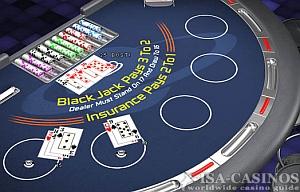
Please note the insurance bet on offer, i.e. the protective bet that applies when the croupier has an ace as his upcard – this gives you the opportunity to insure yourself with up to half of the original stake against a threatening blackjack of the bank. If the croupier gets a blackjack, the player loses nothing, because the insurance bet pays 2:1. Conversely: if the croupier does not get a blackjack, the insurance bet loses. Should the player always take insurance, for example when he has 20? Or rather not?
Mathematically it looks like this: the average house edge on the insurance bet for a game with 6 decks is 7.40 %.
And so the question is answered: you should never take insurance, because in the long run you will lose more money than you would lose without this insurance bet.
Please note that the calculation of the house edge on the insurance bet is based on the same considerations as the perfect strategy. However, the whole thing can also be calculated by working out the probability that the croupier will get a blackjack if his first card is an ace, regardless of all the cards that have already been dealt in the game. Then it would look roughly like this:
6 decks = 312 cards (96 cards with a value of 10). In the remaining deck, if the croupier has an ace: 311 cards, of which 96 give the bank a blackjack. Mathematically, the croupier gets a blackjack at (215:96):1, i.e. 2.24:1 against.
While the effective probability is 2.24:1, the payout on the insurance bet is 2:1. This bet is therefore not recommended (except for blackjack counters).
Baccarat or punto banco
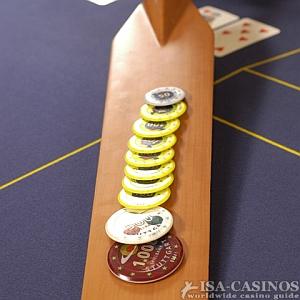
While in the card game blackjack the magic value is 21, in this game it is 9. The closer you are to 9, the better. Picture cards count 10 or are worth zero; only the units value counts for the final result. So a 9 and a 6 do not have the value 15, but 5. And A-A is not worth 22, nor 12, but 2. The cards are dealt one by one until both the player side and the bank side have a maximum of 3 cards, after which it must be decided which side has won. The player can bet either on the bank side (banco) or on the player side (punto). The drawing rules are fixed according to a certain pattern.
For simplicity and topicality, we refer here to the calculations of the chances at punto banco, where the drawing rules are fixed in every situation. While in chemin de fer the drawing rules vary depending on how many players are involved in the hand, in punto banco (mini baccarat) the cards are drawn according to the traditional variant, i.e. regardless of what influence drawing the third card could have for the bank. Even though the bank can see the cards, play follows a fixed rule.
The best way to imagine it is that in punto banco the bank theoretically does NOT SEE the player’s first two cards and therefore has to decide according to the mathematically optimal strategy whether the third card must be drawn for the bank or not. This is further influenced by the fact that the bank has to look at the value of its first two cards and how strongly the value of the player’s third card could influence this card value, both positively and negatively. For example, a low third card improves the player’s value massively – especially a 3, 4 or 5 will usually improve the player’s points – while a 10 of course changes nothing and an 8 or 9 in most cases leads to a worse score for the player. To sum up, it can therefore be said that in punto banco the banco must draw the third card liberally if the player’s third card gives a low score. The detailed drawing rules are all based on mathematically optimal considerations and are fixed, but the player still has to decide whether to bet on punto (player) or on banco (bank side).
While the player who bets on punto receives a payout of 1:1 if he wins, winnings on the banco side are subject to a commission of 5 % (rarely 4 % is taken). So whoever bets 100 on banco and banco wins receives 95 in winnings. On punto, with a stake of 100, you are accordingly paid 100.
As the player first has to decide whether to draw a third card or not, the bank can first look at the card value the player receives and thus “theoretically” consider whether it wants to draw another card. As already mentioned, this decision is defined by the official and internationally customary drawing rules, and this makes the game efficient and comprehensible. But since banco will win more often than punto in the long run, while the payout on punto is somewhat higher than on banco, it is not visible at first glance which bet is better in the long run in this game, i.e. subject to a smaller house edge. This again can only be calculated with computer simulations and finally becomes clearly visible over hundreds of thousands of games.
Despite the 5 % commission, the bank’s edge is of course not 5 %, because banco wins much more often. The result is as follows:
- Banco: −1.06 %
- Punto: −1.24 %
In other words: in the long run it is better for the player always to bet only on banco as a matter of principle, instead of paying attention to the tables and scribbles on his notepad and trying to recognise a trend.
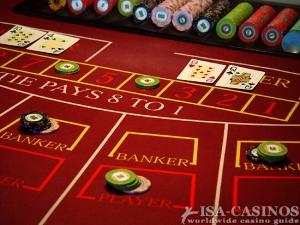
Besides the option of choosing banco or punto, punto banco also offers the bet that both sides will reach a tie. This is a bet that pays 8:1 if it wins. The layout of punto banco tables may occasionally also say: “Any Tie 9 for 1” or “Tie pays 8:1”. But both are the same and merely a different way of saying it. The term “9 for 1” arose because in some casinos it was customary to pay 9 times the stake “into the hand” of the winner and to keep the original stake after all payouts had been completed. But then some casino managers had the idea that it would be cheaper to pay out only 8 times and instead leave the player’s stake in the tie field, so that he might bet on the tie again in the following game.
Which brings us to the decisive question: how high is the house edge on the tie bet in punto banco?
Well, the probability of a tie is 9.5156 %. The payout, however, is 8:1 (plus stake). Because of this glaring difference, the house edge is a whole 14.36 % and the bet is therefore not to be recommended as a standard bet. Only bet on égalité if you have counted all the cards and know that only picture cards will appear in the very last coup. Then you can bet the maximum on égalité, because you know that égalité must win. The problem with all this, however, is on the one hand that this situation will occur extremely rarely: it is very unlikely that only picture cards will be left at the end of the shoe after a standard shuffle. On the other hand, it is not necessarily everyone’s cup of tea to count the cards at punto banco for days without placing a bet and wait for a +13 as the index after 299 cards dealt in order to start playing. But then it is guaranteed that tie will win and you can quickly make your big win of the evening.
Caribbean Stud Poker – Tropical Stud Poker
As the name already suggests, this very popular card game comes from the warmer regions of this planet and was first played at the Grand Holiday Inn Casino on Aruba. It experienced an incredible boom there and was later, in the early 1990s, introduced in the casinos of Nevada.
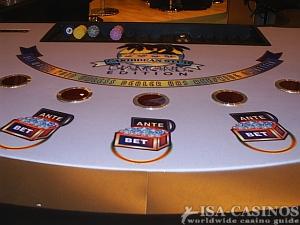
Since then this game has taken on a decisive place in the casino scene and is now indispensable. It is played at a table of the size and height of a blackjack table. An ordinary deck of 52 cards is used for a game, although today, for reasons of time and efficiency, card shufflers and a second deck are used. While one game is in progress, the shuffler automatically shuffles the other deck, which means more games can be played per hour. At the beginning of the game each player places an ante in a field in front of him, indicating that he wants to receive cards.
Unlike the otherwise usual and traditional poker variants, in which the players play against each other and the house charges a commission for running the game, in Caribbean Stud Poker all (maximum 7) players each play on their own against the bank. The aim is to get the strongest possible hand and then compare it with the bank’s hand. If you are stronger than the bank, you receive a payout of a fixed amount according to the pay table. If you have a weaker hand and consider it hopeless compared with the bank’s hand, you can forfeit your stake (ante) and throw away your hand. Otherwise, in addition to your ante you place the so-called bet, which is twice the ante, and put your 5 cards face down under the stake. This indicates that you are “playing”, and then the 5 cards are compared with the bank’s 5 cards. If, on the other hand, the bank is not able to have at least a small pair (or even less: an ace-king), the bank does not “play”. This means the bank forgoes the comparison and instead pays out the antes of the players in the game, and the bets are cancelled, i.e. then taken back by the player. So much for the basic rule of this game. And now something about the mathematics.
In this game, too, there are things you have to bear in mind if you want to use the optimal chances.
An experienced player who has looked into probability calculation a little will know that in Caribbean Stud Poker he should always and only make his bet if he has at least A-K-J-x-x in his hand – or any pair and better. The simple reason for this is that he will then also win with A-K high if the bank also has A-K-x-x-x. Because it is then more likely that the bank’s third card is not a queen or a jack but lower. And so the player would win with A-K-J-x-x, with ace high alone.
An inexperienced player approaches the matter with different considerations. Many players only place their bets when they have a pair in their hand that is higher than the bank’s open card (one of the bank’s five cards is placed face up to help the players estimate whether they can win against the bank with their hand or not). But this consideration is a fallacy that does not work out mathematically either. Whoever throws away the small pairs lower than the bank’s upcard and does not play misses out on money, namely in all those situations in which the bank has an even smaller pair – or none at all or A-K high. Because always remember: even a lousy pair of twos is still better than nothing and brings in a few chips.
The division that ultimately says something about the bank’s house edge is usually made in two categories: soft or strong.
A soft player is one who does not play the optimal strategy. This soft player plays with an average negative expectation of around 7.14 %. An average player who sometimes plays correctly but now and then makes one or two mistakes is likely to have an estimated negative expectation of −6 %. Whoever plays the optimum strategy, i.e. throws away his cards or makes the bet exactly right, saves a few percentage points and still has to contend with a house edge of around 5.40 %.
Summary and final analysis
Winning has its price. Or, better put: winning is a little more difficult than losing, because the odds are always a little in favour of the house. This price that a player has to pay if he wants to win can, however, vary from game to game or from chance to chance. Roulette, which is generally considered the fairest game of chance, has the advantage that, with the exception of the bets on the even chances (supermarket), all other chances have the same payout rates, in percentage terms relative to the probability of a chance occurring. So you can do relatively little wrong here, no matter where or what you bet on the numbers: the chances are always the same, and the same for everyone.
Card games are a little different. Especially in blackjack, where the chances change constantly, the player can improve his chances somewhat through ideal play (perfect strategy), as the dealer’s upcard has a direct and immediate influence on the chances of the dealer busting or reaching a high final total, etc. Another reason is that used cards leave the game, unless a recycling shuffler is used. Whoever plays blackjack and is not familiar with the rules has a harder time here: every mistake you make – for example because you do NOT draw on 15 or do not split A-A and continue playing on two boxes because you would rather draw until you are as close as possible to 21 without increasing the stake – will lead to a higher negative expectation in the long run, and you will therefore probably lose more money. The insurance bet, for example, is something you should avoid. Instead, at the end of your gaming session you can pay the parking meter with the money you have saved by not playing the insurance bet two or three times.
Avoid all side bets at blackjack. What is popular in many places – such as the perfect pair bet or bets on whether you will get a blackjack with the next hand or the like – are bets that make the adrenaline shoot up in the short term when the win occurs, but in the long run you have too many disadvantages on these chances, which is why they should actually be ignored.
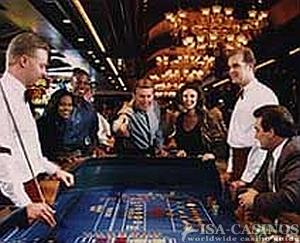
On this occasion we would like to point out another game that is basically even fairer than roulette – namely craps. Craps is a dice game that is especially popular in American, Australian or Caribbean casinos. In craps there are chances that can be very profitable and lucrative for the player under certain circumstances. Some casinos offer craps with rules that are so attractive for the player that with perfect play he plays against a house edge of a slim 0.184 % (!!!). This is the best bet in craps of all and applies at tables where the casino offers 10x odds on the pass line bet. But just as in other games, the bets that are most fun in the dice game, i.e. the bets on the outcome of a single roll and the like, are the most expensive bets for the player. As craps is not very well known in Europe, we have refrained from giving you a detailed report on this game. If you ever visit a casino in the Caribbean on holiday and pass a busy craps table, you should simply know the following: always play the pass line with the table minimum, and when a point is established, i.e. 4, 5, 6, 8, 9 or 10, you should back up your original bet with the maximum stake allowed by the casino (5x, 10x or 20x, very rarely 100x). On these so-called “odds” there is no house edge, so this is a completely neutral bet without any advantage for the casino.
As new games are constantly coming onto the market, it will always be necessary to keep informed about innovations, changes and the like. Today we have introduced you to the most important games, which will serve you as good tools for your next casino visit. Despite all these tips, you will practically never be in a position to bet on a chance with a guaranteed win for you. The luck factor will always be your companion, and you will need it to fill your pockets with the casinos’ money. So always remember: use your head where possible, play within your means, and above all: play for fun and pleasure. When the fun stops, it is time for you to think about what you are doing and why you are doing it.
Sources
The facts were checked against the following sources:
- The percentages can be recalculated mathematically: with 37 numbers (1 to 36 and zero) and a payout of 35:1 on a single number, the house edge is 1/37 = 2.70 %; with the prison rule it is halved to 1.35 % on the even-money chances. The calculation examples (18,000 games at 100, loss of 24,300 or 48,600) have been recalculated and are correct.
- The report appeared in the "Gewinnchancen-Optimierer" of May 2005 (see "New issue of the “Gewinnchancen-Optimierer”, May 2005").
- The blackjack figures can be checked: with 6 decks, after an ace for the bank there are still 96 ten-value cards among 311 cards, i.e. 215:96 = 2.24:1 against a blackjack; with a payout of 2:1 this gives the insurance a house edge of (215 − 192) : 311 = 7.4 %.
- House edge at punto banco (banco 1.06 %, punto 1.24 %, égalité at a payout of 8:1 around 14.4 %): https://en.wikipedia.org/wiki/Baccarat
- Craps: the pass line has a house edge of 1.414 %; together with 10x odds it drops to 0.184 % of the total stake: https://en.wikipedia.org/wiki/Craps
- The parts on blackjack, punto banco and Caribbean Stud Poker appeared online at ISA-CASINOS from 1 to 4 April 2005.